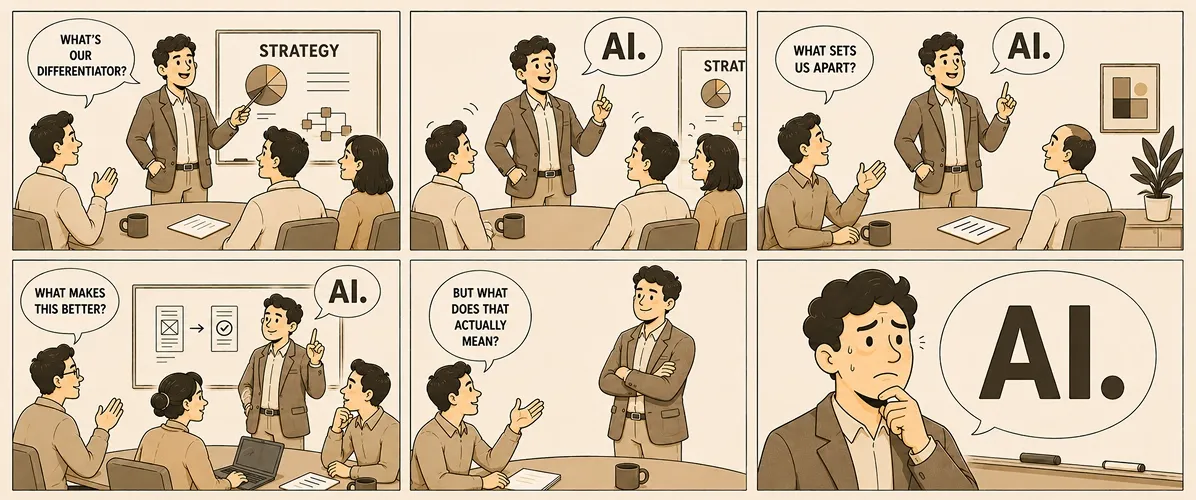
If the answer is no, you don't have a positioning problem. You have a strategy problem. AI is masking the absence of a clear point of view about what you do and why it matters. The strongest AI native companies could remove the word "AI" entirely and still have a compelling narrative.
For years, technology companies have competed on similar messages: digital transformation, innovation, and trusted partnerships.
In the AI era, that is no longer enough.
Customers aren't looking for vendors who can implement technology. They're looking for partners who can accelerate business outcomes. The conversation has shifted from "What can you build?" to "How fast can you create value?"
This is why the next generation of market leaders won't position themselves as IT services companies. They'll position themselves as AI acceleration companies.
The Positioning Trap Most Companies Fall Into
Here's the uncomfortable truth: most companies are stuck in what I call the "AI Adjective Trap." They take their existing identity and simply bolt "AI powered" onto it.
- AI powered consulting
- AI enhanced services
- AI driven solutions
This isn't positioning. It's decoration.
The problem? When everyone adds the same adjective, no one stands out. You're competing on the same axis as everyone else, just with slightly different vocabulary.
“When everyone adds the same adjective, no one stands out.”
What New Generation AI Companies Are Doing Right
ElevenLabs
ElevenLabs isn't selling voice technology. It's building the future of AI powered communication. Notice how its positioning transcends the product. It isn't about text to speech quality or voice cloning accuracy. It's about removing barriers between ideas and expression.
Ramp
Ramp doesn't market expense management software. It markets financial efficiency and autonomous finance operations powered by AI. The product is a credit card and expense tool. The positioning is "time is money, and we give you both back."
Thinking Machines Lab
Founded by former OpenAI CTO Mira Murati, Thinking Machines Lab is positioning itself around making AI more understandable, customizable, and human centered, not simply building better models. In a sea of companies racing toward capability, they're racing toward comprehensibility.
Cursor
Worth adding to this list: Cursor didn't position itself as "an IDE with AI features." It positioned itself as the way developers will write code going forward. The product is a code editor. The category is the future of software creation itself.
The Belief Gap: Where Most Positioning Falls Apart
Strong positioning isn't just about what you do. It's about what you believe that others don't.
Consider these belief statements:
The weak beliefs are true but generic. The strong beliefs are arguable, and that's exactly what makes them powerful. They attract customers who share the belief and repel those who don't.
That's not a bug. That's positioning working correctly.
The New Positioning Framework
To win in the AI era, every company should answer:
- What business outcome do we accelerate? (Not "what technology do we provide")
- What category are we creating? (Not "what category do we compete in")
- What future are we helping customers achieve? (Not "what problems do we solve today")
- What belief do we want to own? (Not "what do we want to be known for")
The companies that answer these questions well won't just adopt AI. They'll redefine their market position because of it.
AI Native Brands: The Next Competitive Advantage
Every company today claims to use AI.
Very few are truly AI native.
The difference is becoming increasingly visible to customers, investors, and talent.
AI is not an addition. It's the operating model.
What Makes an AI Native Brand?
They Sell Outcomes, Not Features
- Ramp sells financial efficiency, not software.
- ElevenLabs sells communication without barriers, not voice generation.
- Midjourney sells creative exploration, not image generation.
They Build Systems, Not Tools
AI native companies think beyond individual products and build intelligent ecosystems that improve over time. This creates a compounding advantage that tool focused companies can't replicate.
They Lead with Vision
The strongest AI brands talk about the future they're creating, not the technology they use. They paint a picture of what becomes possible when their vision is realized.
They Embrace Radical Transparency About Limitations
Counterintuitively, AI native brands are often more honest about what AI can't do. They know that overpromising leads to churn, and that customers who understand the boundaries become better collaborators.
Why Customers Are Noticing the Gap
A few years ago, saying "we use AI" was enough.
Today, customers want to know:
- Is AI core to your business?
- Does it make you faster?
- Does it create measurable outcomes?
- Can it continuously improve customer experience?
- Are you building something that couldn't have existed before AI, or just a faster version of something that already existed?
The market is moving beyond AI adoption and toward AI maturity. Customers can feel the difference between a company that has truly reimagined itself and one that has simply added a chatbot to its support page.
The Bottom Line
AI is no longer a technology story.
It's a positioning story.
The brands that will lead the next decade are not those that simply use AI. They're the ones that redesign their business, culture, and customer experience around it.
In a world where everyone has access to the same foundation models, the same APIs, and increasingly the same capabilities, being AI native becomes the real competitive advantage.
The question isn't whether you're using AI.
The question is whether AI is using you as the vehicle to create something that couldn't have existed before.